
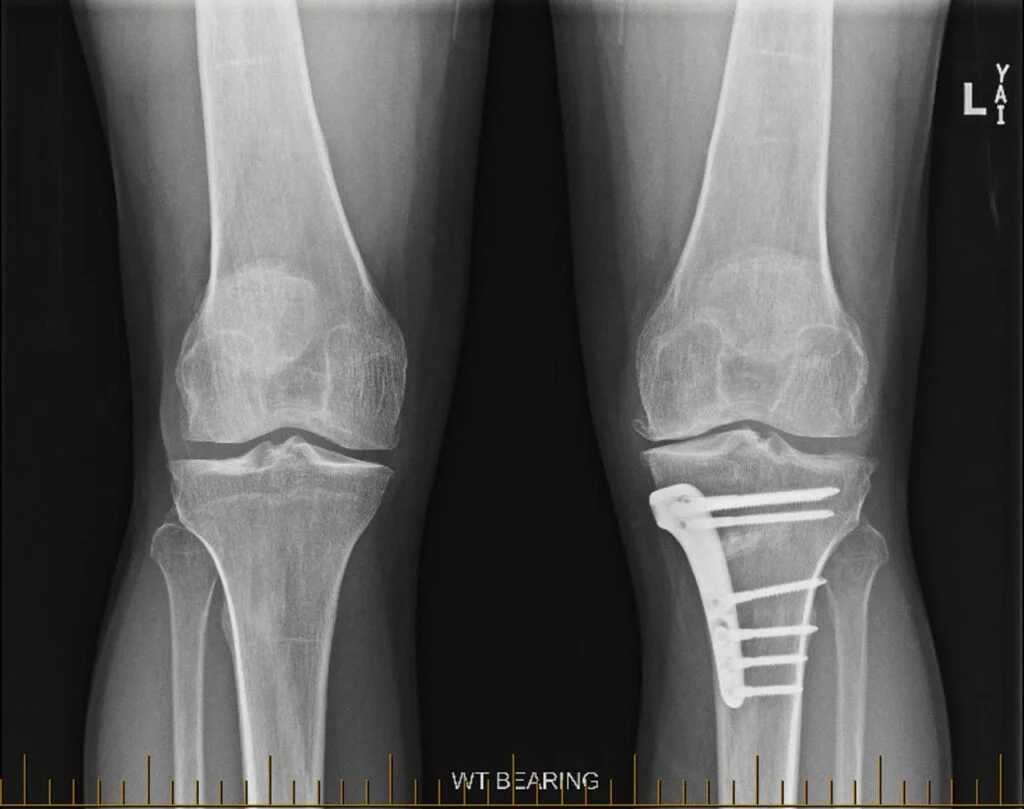
Realigning the knee joint to relieve pain and delay joint replacement
Knee osteotomy is a joint preservation procedure designed to shift the weight bearing load away from the damaged part of the knee joint. This surgery may be recommended for younger or more active patients with knee arthritis that is limited to one side of the knee. By adjusting the alignment of the leg, knee osteotomy can help reduce pain, improve function, and potentially delay the need for a total knee replacement.
Dr George Awwad offers knee osteotomy as part of his comprehensive approach to knee care, helping selected patients manage their arthritis while maintaining an active lifestyle.
What is a knee osteotomy?
A knee osteotomy is a surgical procedure that involves reshaping or repositioning one of the bones in the leg, either the tibia (shinbone) or femur (thighbone), to improve the alignment of the knee joint. This realignment helps shift weight away from a damaged or arthritic area of the knee, which may reduce pain and improve function in people with localised knee arthritis or deformity. Rather than replacing the knee joint with an implant, a knee osteotomy aims to preserve the patient’s natural joint for as long as possible. By redistributing pressure across the joint, the procedure can help slow the progression of arthritis and potentially delay or avoid the need for total knee replacement surgery.
Knee osteotomy is generally considered for active patients who have arthritis in just one part of the knee, good range of motion, and a healthy body weight. It is most commonly used to treat medial (inner) compartment osteoarthritis in patients with a bow-legged (varus) alignment. Dr George Awwad offers knee osteotomy as part of a tailored joint preservation plan, taking into account each patient’s symptoms, lifestyle, goals, and imaging results.
Types of knee osteotomy: high tibial vs distal femoral
There are two main types of knee osteotomy procedures, each targeting a different bone depending on the direction of joint misalignment:
High Tibial Osteotomy (HTO)
A high tibial osteotomy involves cutting and reshaping the upper part of the tibia (shinbone). It is most commonly used in patients with varus deformity, where the knees are bowed outward and excess pressure is placed on the inner (medial) compartment of the knee. HTO works by shifting the body’s weight toward the less affected outer (lateral) part of the knee joint, aiming to reduce pain, improve function, and delay the progression of medial compartment osteoarthritis. This is the most common type of osteotomy performed for knee joint preservation.
Distal Femoral Osteotomy (DFO)
A distal femoral osteotomy targets the lower end of the femur (thighbone) and is typically used in patients with a valgus deformity, where the knees angle inward (“knock-knee”). This deformity puts more pressure on the outer (lateral) compartment of the knee.
By realigning the femur, a DFO redistributes the mechanical forces more evenly across the knee joint, relieving symptoms and potentially delaying the need for joint replacement in selected patients.
When is a knee osteotomy surgery typically recommended?
Knee osteotomy surgery may be recommended for active patients with early-to-moderate knee osteoarthritis that affects only one part of the knee, either the medial (inside) or lateral (outside) compartment. The procedure is often considered in the following situations:
Unicompartmental (partial) knee arthritis
Osteotomy is most effective when joint damage is limited to one compartment of the knee. Realigning the joint may help offload the worn area and shift weight toward the healthier cartilage, potentially delaying the need for joint replacement surgery.
Malalignment of the knee joint
Patients with bow-legged (varus) or knock-kneed (valgus) alignment may benefit from osteotomy to redistribute joint pressure more evenly. These alignment issues often contribute to the progression of arthritis in the overloaded compartment.
Young or active individuals
Osteotomy may be preferred in younger, physically active patients who are not ideal candidates for total knee replacement. The goal is to preserve the natural knee joint for as long as possible while reducing pain and improving function.
Knee pain that worsens with activity
If symptoms like pain, stiffness, or swelling are affecting your ability to participate in work, sport, or daily tasks and these symptoms are linked to joint malalignment or isolated arthritis, osteotomy may be part of a joint preservation strategy.
Preserved knee motion and cartilage in other compartments
Knee osteotomy is usually only considered when the remaining compartments of the knee are relatively healthy and joint range of motion is well preserved.
Unicompartmental (partial) knee arthritis
Osteotomy is most effective when joint damage is limited to one compartment of the knee. Realigning the joint may help offload the worn area and shift weight toward the healthier cartilage, potentially delaying the need for joint replacement surgery.
Malalignment of the knee joint
Patients with bow-legged (varus) or knock-kneed (valgus) alignment may benefit from osteotomy to redistribute joint pressure more evenly. These alignment issues often contribute to the progression of arthritis in the overloaded compartment.
Young or active individuals
Osteotomy may be preferred in younger, physically active patients who are not ideal candidates for total knee replacement. The goal is to preserve the natural knee joint for as long as possible while reducing pain and improving function.
Knee pain that worsens with activity
If symptoms like pain, stiffness, or swelling are affecting your ability to participate in work, sport, or daily tasks and these symptoms are linked to joint malalignment or isolated arthritis, osteotomy may be part of a joint preservation strategy.
Preserved knee motion and cartilage in other compartments
Knee osteotomy is usually only considered when the remaining compartments of the knee are relatively healthy and joint range of motion is well preserved.
Who might be a suitable candidate for knee osteotomy surgery?
Knee osteotomy is typically considered for patients who have specific characteristics that make them better suited to this joint-preserving approach rather than knee replacement surgery. It is not a universal solution for all knee arthritis, and careful assessment is essential.
Younger and active individuals
Knee osteotomy may be more appropriate for patients under the age of 60 who lead active lifestyles and wish to delay or avoid knee replacement. These individuals often place greater demands on their joints and benefit from retaining their natural knee for as long as possible.
Isolated compartment osteoarthritis
Patients with arthritis limited to just one part of the knee (commonly the medial or lateral compartment) may benefit from an osteotomy, especially if there is associated joint malalignment. This helps shift the load away from the damaged cartilage toward the healthier side of the joint.
Correctable knee alignment (varus or valgus)
Osteotomy is most effective in patients with a correctable deformity, such as bow-legged (varus) or knock-kneed (valgus) alignment. Realignment of the leg can reduce pressure on the affected compartment and slow arthritis progression.
Preserved range of motion and healthy surrounding cartilage
Candidates should have a good range of motion and minimal damage to the other compartments of the knee joint. If there is widespread arthritis or severe stiffness, osteotomy may not be appropriate.
Healthy bone quality
Adequate bone strength is important to allow healing after the osteotomy. Poor bone quality, such as from advanced osteoporosis, may affect surgical outcomes and suitability.
Realistic expectations and commitment to rehabilitation
As with any orthopaedic procedure, success also depends on the patient’s commitment to post-operative rehabilitation and having realistic goals. Osteotomy aims to relieve pain, improve alignment, and delay joint replacement—not necessarily to fully restore a “normal” knee.
Younger and active individuals
Knee osteotomy may be more appropriate for patients under the age of 60 who lead active lifestyles and wish to delay or avoid knee replacement. These individuals often place greater demands on their joints and benefit from retaining their natural knee for as long as possible.
Isolated compartment osteoarthritis
Patients with arthritis limited to just one part of the knee (commonly the medial or lateral compartment) may benefit from an osteotomy, especially if there is associated joint malalignment. This helps shift the load away from the damaged cartilage toward the healthier side of the joint.
Correctable knee alignment (varus or valgus)
Osteotomy is most effective in patients with a correctable deformity, such as bow-legged (varus) or knock-kneed (valgus) alignment. Realignment of the leg can reduce pressure on the affected compartment and slow arthritis progression.
Preserved range of motion and healthy surrounding cartilage
Candidates should have a good range of motion and minimal damage to the other compartments of the knee joint. If there is widespread arthritis or severe stiffness, osteotomy may not be appropriate.
Healthy bone quality
Adequate bone strength is important to allow healing after the osteotomy. Poor bone quality, such as from advanced osteoporosis, may affect surgical outcomes and suitability.
Realistic expectations and commitment to rehabilitation
As with any orthopaedic procedure, success also depends on the patient’s commitment to post-operative rehabilitation and having realistic goals. Osteotomy aims to relieve pain, improve alignment, and delay joint replacement—not necessarily to fully restore a “normal” knee.
Who may not be suitable for a knee osteotomy?
While knee osteotomy may offer pain relief and improved function for selected patients, it is not the right procedure for everyone. Some individuals may not benefit from this type of surgery, and in such cases, alternative treatments, such as total or partial knee replacement may be more appropriate.
Patients usually not suitable for a knee osteotomy include those with:
Advanced, multi-compartment arthritis
Osteotomy is most effective when only one compartment of the knee is affected by arthritis. If the damage extends to multiple areas of the joint, a realignment procedure is unlikely to provide sufficient long-term relief and may even worsen symptoms.
Severe stiffness or limited range of motion
Patients with significantly reduced knee movement or longstanding stiffness may not achieve a good outcome with osteotomy, as the surgery is less effective when joint mobility is already compromised.
Inflammatory arthritis or systemic joint disease
Conditions like rheumatoid arthritis or other inflammatory joint diseases often affect the entire knee, making joint realignment procedures less suitable. These patients may benefit more from joint replacement surgery or other medical therapies.
Poor bone quality
Adequate bone strength is necessary for the osteotomy to heal effectively. People with osteoporosis or other conditions that weaken bone may be at increased risk of non-union or implant failure.
Obesity
Excess weight can place significant stress on the knee joint and may increase the risk of complications after osteotomy. In some cases, weight loss may be recommended before surgery is considered.
Smokers
Smoking can impair healing after surgery and increase the risk of complications such as delayed bone healing or infection. Smoking cessation is usually advised before and after osteotomy.
Unrealistic expectations
Patients who expect a complete return to high-impact sports or full joint restoration may be disappointed. Osteotomy is designed to delay knee replacement and improve quality of life, not to “cure” arthritis or create a perfect joint.
Advanced, multi-compartment arthritis
Osteotomy is most effective when only one compartment of the knee is affected by arthritis. If the damage extends to multiple areas of the joint, a realignment procedure is unlikely to provide sufficient long-term relief and may even worsen symptoms.
Severe stiffness or limited range of motion
Patients with significantly reduced knee movement or longstanding stiffness may not achieve a good outcome with osteotomy, as the surgery is less effective when joint mobility is already compromised.
Inflammatory arthritis or systemic joint disease
Conditions like rheumatoid arthritis or other inflammatory joint diseases often affect the entire knee, making joint realignment procedures less suitable. These patients may benefit more from joint replacement surgery or other medical therapies.
Poor bone quality
Adequate bone strength is necessary for the osteotomy to heal effectively. People with osteoporosis or other conditions that weaken bone may be at increased risk of non-union or implant failure.
Obesity
Excess weight can place significant stress on the knee joint and may increase the risk of complications after osteotomy. In some cases, weight loss may be recommended before surgery is considered.
Smokers
Smoking can impair healing after surgery and increase the risk of complications such as delayed bone healing or infection. Smoking cessation is usually advised before and after osteotomy.
Unrealistic expectations
Patients who expect a complete return to high-impact sports or full joint restoration may be disappointed. Osteotomy is designed to delay knee replacement and improve quality of life, not to “cure” arthritis or create a perfect joint.
Knee osteotomy vs partial vs total knee replacement: what’s the difference?
If you are living with knee pain caused by arthritis or joint damage, there are several surgical treatment options available. The most appropriate approach depends on the severity, location, and pattern of joint wear, as well as your age, activity level, and treatment goals. Below is a comparison of knee osteotomy, partial knee replacement, and total knee replacement.
Knee Osteotomy
A knee osteotomy involves reshaping or realigning the bones of the leg to offload pressure from the damaged part of the knee joint. It is typically recommended for younger or active patients who have arthritis affecting only one side (compartment) of the knee:
-
Best suited for: Isolated medial or lateral compartment arthritis in younger, active individuals. -
Goal: To preserve the natural joint, reduce pain, and delay the need for knee replacement. -
Advantages: Retains native joint surfaces, may allow return to higher-impact activities. -
Considerations: Longer bone healing time; less suitable for advanced arthritis.
Partial Knee Replacement
Partial knee replacement (unicompartmental arthroplasty) involves replacing only the damaged compartment of the knee with a prosthetic implant. The rest of the joint, including the ligaments and cartilage in the unaffected areas, is preserved.
-
Best suited for: Patients with moderate arthritis confined to one compartment, and good ligament function. -
Goal: To relieve pain while maintaining more natural joint movement. -
Advantages: Smaller incision, quicker recovery, retains more natural function. -
Considerations: Not appropriate for widespread arthritis or instability; risk of progression in other compartments.
Total Knee Replacement
Total knee replacement (arthroplasty) involves removing damaged cartilage and bone from the entire joint and replacing them with artificial components that resurface the femur, tibia, and sometimes the patella.
-
Best suited for: Patients with severe, multi-compartment arthritis that limits mobility and quality of life. -
Goal: To provide long-term pain relief and restore function across the whole joint. -
Advantages: High success rate for pain relief and improved mobility. -
Considerations: Recovery time may be longer; joint mechanics may feel less natural than with native tissue.
Choosing the Right Approach
Dr George Awwad will perform a detailed clinical evaluation and review imaging to help determine which treatment aligns best with your symptoms, anatomy, and long term goals. Not every patient is suited to every procedure, and understanding the differences can help guide shared decision making.
Your knee osteotomy journey with Dr George Awwad: step by step
Undergoing knee osteotomy surgery is a carefully planned process that begins well before your procedure and continues through your rehabilitation and return to activity. Dr George Awwad will guide you through each step of the journey to help ensure your experience is safe, supported, and tailored to your individual needs.
1. Initial Consultation and Assessment
Your journey begins with a thorough clinical evaluation at Dr Awwad’s rooms. During this appointment:
-
You will discuss your symptoms, lifestyle, and treatment goals. -
Dr Awwad will perform a physical examination of your knee. -
X-rays and other imaging (e.g. long-leg alignment films or MRI) will be reviewed to assess the joint surfaces and leg alignment. -
Based on this assessment, Dr Awwad will determine whether a knee osteotomy may be suitable for your condition.
2. Preoperative Planning
If surgery is recommended, Dr Awwad will:
-
Develop a personalised surgical plan based on your imaging and anatomy. -
Determine the appropriate type of osteotomy (e.g. high tibial or distal femoral) and calculate the exact degree of correction needed. -
Discuss the procedure with you in detail, including expected benefits, risks, and alternatives. -
Provide guidance on optimising your health before surgery, such as smoking cessation, managing chronic conditions, or strengthening the surrounding muscles through physiotherapy.
3. Admission and Anaesthesia
On the day of your procedure:
-
You will be admitted to hospital and meet the anaesthetic team. -
Most knee osteotomies are performed under general anaesthetic, sometimes combined with a regional block for pain relief. -
You will be monitored closely throughout your admission to ensure comfort and safety.
4. The Surgical Procedure
During the operation:
-
A small cut is made to access the tibia or femur, depending on the planned correction. -
A carefully measured wedge of bone is either removed (closing wedge) or created (opening wedge). -
The bone is realigned to redistribute load away from the worn part of the knee. -
The new alignment is secured with a specialised plate and screws. -
Bone graft or synthetic material may be used to support healing if needed.
5. Recovery in Hospital
After surgery:
-
You may stay in hospital for 1–2 nights depending on your recovery and mobility. -
Pain is managed with medications and ice therapy. -
A physiotherapist will assist with gentle movement, walking, and early exercises. -
You will usually begin partial weight-bearing with crutches soon after surgery.
6. Rehabilitation at Home
Following discharge:
-
You will continue physiotherapy to gradually restore strength, mobility, and function. -
Dr Awwad will advise when to increase weight-bearing based on your progress and X-ray results. -
Most patients use crutches or a walking aid for 4–6 weeks. -
Regular follow-up appointments will be scheduled to monitor healing.
7. Return to Activities
Recovery timelines vary depending on your individual progress:
-
Driving may resume after 4–6 weeks when you can safely control the vehicle. -
Return to office-based work is often possible after 2–4 weeks. -
More physically demanding jobs may require a longer break. -
Low-impact exercise can usually begin around 3 months, with return to sport sometimes taking 6–12 months.
8. Long-Term Monitoring
Dr Awwad will continue to monitor your knee alignment and joint health over time. A successful knee osteotomy may significantly delay or reduce the need for joint replacement surgery and allow you to maintain an active lifestyle for many years.
Your journey begins with a thorough clinical evaluation at Dr Awwad’s rooms. During this appointment:
-
You will discuss your symptoms, lifestyle, and treatment goals. -
Dr Awwad will perform a physical examination of your knee. -
X-rays and other imaging (e.g. long-leg alignment films or MRI) will be reviewed to assess the joint surfaces and leg alignment. -
Based on this assessment, Dr Awwad will determine whether a knee osteotomy may be suitable for your condition.
If surgery is recommended, Dr Awwad will:
-
Develop a personalised surgical plan based on your imaging and anatomy. -
Determine the appropriate type of osteotomy (e.g. high tibial or distal femoral) and calculate the exact degree of correction needed. -
Discuss the procedure with you in detail, including expected benefits, risks, and alternatives. -
Provide guidance on optimising your health before surgery, such as smoking cessation, managing chronic conditions, or strengthening the surrounding muscles through physiotherapy.
On the day of your procedure:
-
You will be admitted to hospital and meet the anaesthetic team. -
Most knee osteotomies are performed under general anaesthetic, sometimes combined with a regional block for pain relief. -
You will be monitored closely throughout your admission to ensure comfort and safety.
During the operation:
-
A small cut is made to access the tibia or femur, depending on the planned correction. -
A carefully measured wedge of bone is either removed (closing wedge) or created (opening wedge). -
The bone is realigned to redistribute load away from the worn part of the knee. -
The new alignment is secured with a specialised plate and screws. -
Bone graft or synthetic material may be used to support healing if needed.
After surgery:
-
You may stay in hospital for 1–2 nights depending on your recovery and mobility. -
Pain is managed with medications and ice therapy. -
A physiotherapist will assist with gentle movement, walking, and early exercises. -
You will usually begin partial weight-bearing with crutches soon after surgery.
Following discharge:
-
You will continue physiotherapy to gradually restore strength, mobility, and function. -
Dr Awwad will advise when to increase weight-bearing based on your progress and X-ray results. -
Most patients use crutches or a walking aid for 4–6 weeks. -
Regular follow-up appointments will be scheduled to monitor healing.
Recovery timelines vary depending on your individual progress:
-
Driving may resume after 4–6 weeks when you can safely control the vehicle. -
Return to office-based work is often possible after 2–4 weeks. -
More physically demanding jobs may require a longer break. -
Low-impact exercise can usually begin around 3 months, with return to sport sometimes taking 6–12 months.
Dr Awwad will continue to monitor your knee alignment and joint health over time. A successful knee osteotomy may significantly delay or reduce the need for joint replacement surgery and allow you to maintain an active lifestyle for many years.
What is the recovery process after knee osteotomy?
Recovery after knee osteotomy is gradual and carefully structured to support bone healing, restore mobility, and strengthen the surrounding muscles. Your specific recovery plan will depend on the type of osteotomy performed, your individual anatomy, and your personal goals.
Hospital stay and immediate post-operative care
-
Most patients remain in hospital for 1–2 nights following surgery. -
Pain is managed using oral medications and localised therapies like ice and elevation. -
A physiotherapist will assist you with early mobilisation, including:
-
Bed exercises -
Sitting and standing transfers -
Walking with crutches or a frame
-
A brace or support may be applied depending on the surgical technique used.
Weight-bearing and mobility milestones
-
Weight-bearing is usually restricted initially to allow the bone to heal in its corrected position. -
Partial weight-bearing (with crutches or a walker) may be advised for the first 4 to 6 weeks, gradually increasing based on X-ray confirmation of bone healing. -
Most patients can begin full weight-bearing by 6–8 weeks, although this varies depending on:
-
Whether a wedge was opened or closed -
Whether bone graft or synthetic material was used -
Your overall health and bone quality
Physiotherapy and rehabilitation
-
A structured physiotherapy program plays a key role in your recovery and includes:
-
Gentle range of motion exercises in the early weeks -
Gradual muscle strengthening of the quadriceps, hamstrings, and calf -
Balance and gait retraining -
Activity-specific exercises once weight-bearing improves
-
Physiotherapy typically begins in hospital and continues after discharge through outpatient or home-based care.
Return to daily activities
The timeline for returning to normal tasks varies between individuals but may include:
| Activity | Activity Typical Timeline (guidance only) |
|---|---|
| Driving | 4–6 weeks (once able to control vehicle safely) |
| Office-based work | 2–4 weeks |
| Manual work | 8–12+ weeks |
| Low-impact activities | 3 months |
| High-impact sport | 6–12 months (depending on recovery and surgeon advice) |
Monitoring your progress
Dr Awwad will see you for regular follow-ups to assess:
-
Healing of the osteotomy site on X-ray -
Progress in physiotherapy -
Restoration of alignment and function -
Any signs of complications
You’ll be encouraged to keep up with physiotherapy, stay mobile, and gradually increase your activity level under guidance. Full recovery may take several months, but many patients experience significant relief of symptoms and improved function.
What are the potential risks or complications of knee osteotomy surgery?
Knee osteotomy is generally a safe and effective procedure, especially when performed by a qualified orthopaedic surgeon using modern techniques. However, like all surgical procedures, it carries certain risks and potential complications. Understanding these risks is an important part of making an informed decision about your treatment.
General surgical risks
As with any surgery, some general risks apply, including:
-
Infection at the surgical site -
Bleeding or the formation of a haematoma -
Deep vein thrombosis (DVT) or blood clots in the leg -
Adverse reaction to anaesthesia
These risks are typically low and are managed through preventative strategies such as antibiotics, blood thinners, and early mobilisation.
Specific risks associated with knee osteotomy
There are also risks specific to the osteotomy procedure, including:
Non-union or delayed union
The cut bone may take longer than expected to heal, or may not fully unite, requiring further intervention.
Loss of correction
The bone may shift slightly after surgery, especially if the fixation hardware is not holding firmly, or if early weight-bearing occurs before healing.
Over-correction or under-correction
The intended realignment may not be perfectly achieved, which may affect the long-term outcome.
Nerve or blood vessel injury
Though rare, nearby structures may be stretched or irritated during surgery, leading to numbness, tingling, or vascular issues.
Residual pain or stiffness
Some patients may continue to experience discomfort or limited movement, particularly if there is existing joint damage or arthritis.
Compartment syndrome
A rare but serious complication where pressure builds within the muscle compartments, requiring urgent treatment.
Hardware irritation or removal
Plates and screws may cause local discomfort and may need to be removed after the bone has healed.
The cut bone may take longer than expected to heal, or may not fully unite, requiring further intervention.The bone may shift slightly after surgery, especially if the fixation hardware is not holding firmly, or if early weight-bearing occurs before healing.
The intended realignment may not be perfectly achieved, which may affect the long-term outcome.Though rare, nearby structures may be stretched or irritated during surgery, leading to numbness, tingling, or vascular issues.
Some patients may continue to experience discomfort or limited movement, particularly if there is existing joint damage or arthritis.
A rare but serious complication where pressure builds within the muscle compartments, requiring urgent treatment.Plates and screws may cause local discomfort and may need to be removed after the bone has healed.
Long-term considerations
In the long term, some patients may require further procedures, such as:
-
Conversion to knee replacement: If arthritis progresses or symptoms return, a total or partial knee replacement may be needed later in life. A well-executed osteotomy can often delay this need. -
Leg length difference: Minor discrepancies in leg length may occur depending on the amount and type of bone correction.
Monitoring and prevention
Dr Awwad will carefully plan your procedure using advanced imaging and alignment tools to reduce risk. During your recovery, follow-up appointments and X-rays help ensure that healing is progressing as expected. Any complications that do arise can often be managed effectively with early detection and appropriate intervention.
Knee Osteotomy FAQs
Below are answers to some of the most commonly asked questions about knee osteotomy surgery. These responses are designed to support your understanding of the procedure, recovery, and long-term outcomes. During your consultation, Dr George Awwad will provide detailed and personalised information based on your condition and goals.
How does knee alignment affect joint loading?
The alignment of your knee significantly influences how weight and pressure are distributed across the joint. In a normally aligned knee, the forces are shared evenly. However, in cases of bow-legged (varus) or knock-kneed (valgus) alignment, increased pressure builds on one side of the joint. Over time, this can lead to uneven cartilage wear and the development or progression of osteoarthritis. Knee osteotomy aims to redistribute these forces more evenly by adjusting the alignment.
How is the bone realigned and stabilised in the procedure?
During a knee osteotomy, either the tibia (shinbone) or femur (thighbone) is precisely cut and repositioned to achieve a corrected angle. The correction is usually maintained using a metal plate and screws. The bone cut may involve either removing a small wedge (closing wedge) or creating a gap that is filled with bone graft material (opening wedge). This stabilisation allows the bone to heal in the new position over time.
When can I return to work, driving, and sport after a knee osteotomy?
-
Return to work: Most people can return to office-based work within 4–6 weeks, but more physically demanding roles may require 3 months or longer. -
Driving: You may resume driving once you have good control of your leg and are no longer reliant on strong pain medications—typically 6–8 weeks post-op. -
Sports and high-impact activity: These are usually resumed 6–9 months after surgery, depending on your recovery and rehabilitation progress.
Dr Awwad will provide tailored guidance based on your occupation, lifestyle, and progress.
The alignment of your knee significantly influences how weight and pressure are distributed across the joint. In a normally aligned knee, the forces are shared evenly. However, in cases of bow-legged (varus) or knock-kneed (valgus) alignment, increased pressure builds on one side of the joint. Over time, this can lead to uneven cartilage wear and the development or progression of osteoarthritis. Knee osteotomy aims to redistribute these forces more evenly by adjusting the alignment.During a knee osteotomy, either the tibia (shinbone) or femur (thighbone) is precisely cut and repositioned to achieve a corrected angle. The correction is usually maintained using a metal plate and screws. The bone cut may involve either removing a small wedge (closing wedge) or creating a gap that is filled with bone graft material (opening wedge). This stabilisation allows the bone to heal in the new position over time.
-
Return to work: Most people can return to office-based work within 4–6 weeks, but more physically demanding roles may require 3 months or longer. -
Driving: You may resume driving once you have good control of your leg and are no longer reliant on strong pain medications—typically 6–8 weeks post-op. -
Sports and high-impact activity: These are usually resumed 6–9 months after surgery, depending on your recovery and rehabilitation progress.
Dr Awwad will provide tailored guidance based on your occupation, lifestyle, and progress.
What role does physiotherapy play in recovery?
Physiotherapy is a vital part of your recovery journey. It helps:
-
Strengthen the surrounding muscles -
Improve joint mobility and flexibility -
Support safe and gradual return to walking and daily activities -
Minimise the risk of post-operative complications, such as stiffness or weakness
Your rehabilitation program will begin early and progress through multiple phases, often lasting several months.
Can knee osteotomy delay or prevent knee replacement?
Yes, for selected patients, knee osteotomy may help delay or avoid the need for a total knee replacement by preserving the native joint. By offloading the worn or damaged side of the joint and improving alignment, the procedure can relieve symptoms and slow further joint deterioration. However, if arthritis progresses, a knee replacement may still be required later. A well-executed osteotomy can provide symptom relief for 5–10 years or more in many cases.
Physiotherapy is a vital part of your recovery journey. It helps:
-
Strengthen the surrounding muscles -
Improve joint mobility and flexibility -
Support safe and gradual return to walking and daily activities -
Minimise the risk of post-operative complications, such as stiffness or weakness
Your rehabilitation program will begin early and progress through multiple phases, often lasting several months.
Yes, for selected patients, knee osteotomy may help delay or avoid the need for a total knee replacement by preserving the native joint. By offloading the worn or damaged side of the joint and improving alignment, the procedure can relieve symptoms and slow further joint deterioration. However, if arthritis progresses, a knee replacement may still be required later. A well-executed osteotomy can provide symptom relief for 5–10 years or more in many cases. If you’re living with pain or stiffness that’s affecting your quality of life, a thorough assessment can help determine the cause and guide the right treatment path.
Book An Appointment